Showing posts with label terms. Show all posts

15 March 2014

Platform agnosticism


A new piece of nomenclature that—like "backstory," perhaps—will rise from obscurity to common use in two weeks flat: "platform agnostic."

I first saw the term in David Denby's January 8th article on the future of Hollywood films. He uses it to refer to the viewing habits of kids, who will "look at movies on any screen at all, large or small."

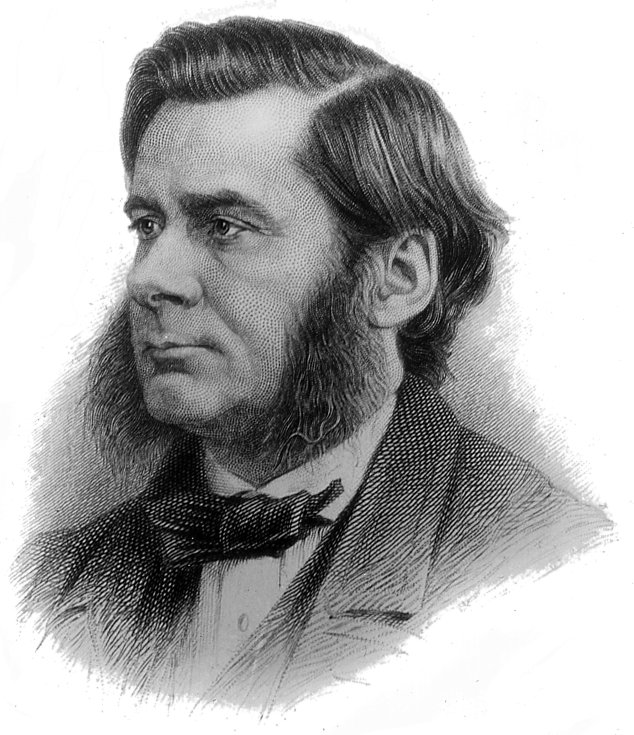
(Photo: Thomas Huxley [1825-95], a great defender of Darwin, who coined the term 'agnostic' to describe his belief that it cannot be known whether or not god exists. The word comes from the Greek—'a' [not] 'gnosis' [knowledge].)

Denby, like most cinephiles (and old people), is not a platform agnostic. He doesn't like how the iPod rides up and down on his stomach when he's watching a movie. And holding it away from his body makes his arm tired. And his eyes hurt to focus. Besides, he's got better options.
"At the house of my friend Harry Pearson, I watched movies on what must be close to the ultimate home-theatre system, a setup priced at two hundred thousand dollars."
So, Mr. Denby, when I start my internship, I'm going to be polite at first. I'll swing by your office and be, like, yeah, no frigging way can we dispense with the Western canon. Nothing about Anthony Lane being funnier. But then...I'm going to get a little more insistent.

Let me put it out there right now: I'll watch whatever you guys are watching. I'll be really quiet. And I will bring the Stroh's.

Talk of platform agnosticism at journalism school is appropriate: the newspaper god is ailing, and journalists have begun to hedge their bets. We take something called Multiplatform Journalism (the 'multi' means print, audio, video, and online), which will help me a tonne when I give up on slackjawed Joe Public and go into advertising.
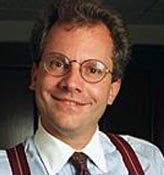
Dorky Times publisher Arthur Sulzberger, Jr., who carries a stuffed toy moose around, also describes himself as a platform agnostic.

Still working on the link between the two.


Originally published on Jan 22, 2007

13 March 2014

New do for summer

Is that hairline getting a little high on the sides? No—can't be.

That's me with Aeisha, my Iraqi barberess. Her shop on 4th Ave. (not a salon, as you can see by the Barbasol receptacle at bottom right) is one of the few places in Vancouver where you can still get the hot-shaving-cream-and-straight-razor treatment, although, to be honest, you can do better in five minutes with your Sensor and some intention. She says some guys make jokes about Iraq while she's scraping their throats with the razor. Reckless, say I.

The reason for the grooming is my temporary leap up the blogging food chain. Today I—drum roll set off in em dashes, please—started a summer internship at Emdashes, which is, as I explained to my family, the Internet's première site about The New Yorker. In no time, I'm sure, Mom will be telling everyone at work that I got a job at the magazine, an elision we should discourage.

I'm working from Vancouver, so the haircut isn't strictly necessary—Emdashes is based in NYC—but with a Kerouackian huzzah and a fit of '20s optimism I decided to make an offering of sideburns to the writing gods. You'll be the first to know how it goes. God, 'Kerouackian' has got to be my favorite name-based adjective.

I spent way too long labouring over my introduction, which, it's not hard to see, comes over as a weak slider for a ball. Give me time, though; it's a comfort zone thing.

Extra listening
Now that we're on the subject, Jack Kerouac reading from "On the Road," in a way both cool and strangely not—your call.

Harry Crosby reading John Updike's "On the Sidewalk," a spot-on Kerouac spoof first published, I believe, in The New Yorker. (I've got it in "Fierce Pajamas" a humor anthology edited by David Remnick and Henry Finder.)

Originally published on May 10, 2007

16 April 2007

Father taught French

Check out my new links section—Where the Wordy Are.

10 April 2007

What would Remnick do?

As you can tell by the previous post, New Yorker-philes, I'm reading Gigi Mahon's "The Last Days of The New Yorker." I need something while I'm jonesing: I left the latest issue of the magazine in Waterhouse's car on the way out to PoCo and I'm three days from a new one in the mail.

The book, as you'd expect, refers to the magazine frequently. There's a quirk of capitalization, however: Mahon capitalizes the "the" only when citing the name of the magazine by itself.
At The New Yorker there was mixed reaction to the news.
They discussed the New Yorker's business prospects.
He presided over a New Yorker annual meeting.
He was leaving The New Yorker to take a job at Hearst.
I have to admit, I'd never thought about the article this way. I'd always assumed it was ponce and chauvinism that compelled The New York Times or The Economist to uppercase the "the." Of course, I'd never seen nine permutations of a journal title on the same page of text before.

Is this the way you wield the article, or is it just a thing between Mahon and her editor?

(JJB Photo: "Sinkmaster.")

27 February 2007

Lexico II

This word has been blipping on my word radar recently: problematic.

From CBC's 'Ideas' last night: "This formulation of a 'spirit-based' tolerance is problematic."

Overheard at a UBC bar: "He has a problematic relationship with alcohol."

It's a usable word, I suppose—as good as worrisome, uncertain, or dangerous. And if my ear is right, it's now in critical vogue. But there's something I don't like about it.

I think it's that it steers the sentence toward thick nouns and adjectives; the verb is almost certain to be mute.

Thoughts?

(Alf, please skip.)

15 February 2007

Word of the Day I

I picked up a new word, courtesy of Kia, who writes:
"Gopnik's writing about art in the New Yorker in the 1990s had an almost emetic effect on the boyfriend I was living with at the time."
According to the OED:
emetic,
a. & n.
  1. Having power to produce vomiting. Also fig. sickening, mawkish.
  2. A medicine that excites vomiting.
I'm thinking emetic sentimentality, emetic public figures, my unhappily emetic response to getting cleated in the groin on a third base somewhere in Etobicoke, Ontario, in 1986.

And, you'll be happy to know, I'm making no mention of Adam Gopnik for at least two weeks. The effect would be, well, grody.

(Alf, please skip.)

12 February 2007

Vows and covenants I

On another note entirely: Can we journalists all agree not to use the adjective 'hard-hitting' anymore?

(Alf, please skip.)

11 January 2007

Ward the King


Stephen Ward, the big dog, the director of the School of Journalism.

I like the guy, let that be said—although it's not for peons to like kings. My feeling runs nearer to trembling awe, so different is the power we wield.

Which is why I've started compiling a list of the weird words he uses. They sound correct, but each time I hear one, I mouth it mentally to myself and promise to look it up.

There were five in our first Press and Society class:
—"issue," pronounced to rhyme with 'miss you';
—"genre," pronounced ZHAHN, like 'John' in French, without the fluttering 'r';
—"propagandic," which should be the name of a hip hair salon;
—"periodicy," which I suspect is missing a couple of letters; and
—"censorial," which I think should be "censorious"—'in a mood to censor.'

It's hard enough getting through the dense vocab in academe without your profs riffing, Miles Davis-like, on the language, no? Then again, maybe he's Cajun or something.

Let's see what the OED says.

Issue
({sm}{shti}{sh}(j)u{lm}, {sm}{shti}sju{lm}) Looks like he's on solid, if slightly poncey, ground on this one. Pushing out that 'y' sound purses your mouth. One for the bossman.

Genre
({zh}{fatatilde}r) Nope, he should definitely be licking the 'r' at the end. One-one.

Propagandic
(Rare) Pertaining to a propaganda or to propagandism. Bugger, thought we had him here. The more common usage is 'propagandistic,' which the OED has as "given or inclined to propagandism; devoted to the propagation of doctrines or principles."

Funny, I'd never noticed the 'pagan' right in the middle of that word. I wonder what pagan propaganda would look like. "Barbecuing ON A SPIT is a SOCIAL GOOD," maybe. Two-one, Ward.

Periodicy
There are no results. The nearest alphabetical match is displayed in the side-frame. Good. I think he was looking for 'periodicity,' or "the quality or character of being periodic; the quality of regular recurrence; tendency to recur at (esp. regular) intervals. {dag}2. Recurrence of a woman's periods; menstruation." Two-two.

Censorial
1. Of, pertaining to, or characteristic of a censor; 2. Of persons: Like a censor; censorious. Wow, I was almost sure that was a mistake.

I'm undone at the end, and the professor snakes the victory, three-two.

Screw it: I've heard him say "orientate" twice. Call it a tie.